talk about what your country / region / city loves
1) Discuss
What is the British stereotype?
What do the British love?
Think of some things we love
2) Watch the clip
What does Britain love?
Can you guess before you watch?
3) Put the words and expressions in order
Look at the list of words and expressions in the exercise below
Do you understand all of them?
Watch the youtube clip again. While you listen, use your mouse to drag the expressions into the right order on the lines.
4) Discuss / Writing
Do you think the ad is true?
What do you love doing?
What do people in your country love doing?
What does your country love?
Make a list of things
Read them out to the class or make a poster.
Grammar
Don't forget - "... loves + a NOUN or VERB +ing"
eg Britain loves a celebration or Britain loves gardening
Look at vocabulary and expressions to describe personality
Discuss keeping diaries and blogs
Discuss and write about an achievement using a variety of past tenses
Discuss and write some IELTS style questions
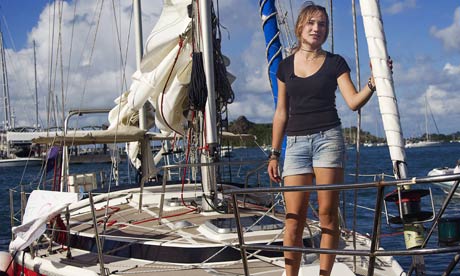
1) Introduction A) Who is Laura Dekker? What do you know about her?
Where is she from?
How old is she?
What is her achievement?
How long did it take?
Why did the authorities try to stop her?
B) Watch the news report to check your answers
C) Watch again, listen and fill in the spaces in the gap-fill exercise with a verb
D) Grammar - Look again. What are the tenses in each sentence?
2) Discuss
Look at the map below
Would you like to sail around the world on your own?
What skills do you think you need?
What kind of a person do you need to be? Think of some adjectives or expressions.
Do you agree with the Dutch authorities that Laura was too young to do the trip?
What do you think Laura learned from the trip?
3) Reading
3a) Read the text below quickly and put these paragraph headings into the correct spaces in the text. Each heading describes the paragraph which follows
A) She is determined
B) She is a reluctant superstar
C) She is good with cockroaches
D) She was born to sail
E) She becomes the youngest person to circumnavigate the globe
Read the text again and find the answers to these questions.
3b) What expressions or adjectives are used to describe Laura? 3c) What did she learn from the trip?
4) Vocabulary
Check / Guess / Find out What do these underlined expressions from the text mean? Try and guess from the other words in the sentence.
Paragraph 1
a trip her father had hoped would "cure her wanderlust"
Paragraph 2 She took on six-metre-high waves and extreme weather heading into the Cape of Good Hope
her storm jib (a sail used in storms) got jammed
Another of her sails ripped completely
She dodged near-collisions with cargo ships
Not in the least squeamish, she had to rescue live flying fish that had flung themselves into her cabin, and scrub the stinking remains of decomposing squid from the deck
the ants and cockroaches that had stowed away in her cabin. Paragraph 3
she set off
in the meantime
Paragraph 4
Dekker has just pipped the previous youngest
Now do the exercise
5) Grammar
Tenses. Look again at part 1D. What were the tenses?
How many tenses can you find in the reading text? Give one example of each.
Find a past simple = She survived weeks at sea...
Find a past continuous =
Find a present perfect =
Find a past perfect =
Find a conditional =
Find a passive =
6) Discuss
What do you think of Laura's achievement?
Do you think she is a heroine?
Was she right to follow her dream or was she too young?
Were the Dutch authorities right to try and stop her?
What are the advantages of keeping a learning diary or blog in English?
Think of an achievement in your lifeand talk about it eg learning to drive, learning English, entering a competition, doing a course...
Why did you decide to do it?
Describe doing it. Was it difficult? How did you feel during and after?
What did you learn from it?
What did you learn about yourself?
7a) Writing
Now write about your achievement
Organise and plan
Paragraph 1 - Introduce the achievement. Say why you wanted to do it. Use past tenses - past simple and continuous / past perfect
Paragraph 2 / 3 - Describe doing it - preparation, difficulties, your feelings. Use past tenses - past simple and continuous / past perfect.Use some adjectives to describe the activity and your feelings.
Paragraph 4 - What have you learnt from doing it? How has it changed your life? How have you changed? What are the benefits? Would you recommend the activity to others? Try and use a variety of tenses; past simple and continuous / past perfect / present perfect / conditional / passive
7b) Writing (IELTS)
Discuss and prepare to write about one of these questions
Should parents be obliged to send their children to school? Or should they have the right to choose how to educate them?
Some people believe that governments have a duty to make sure all their citizens are healthy, safe and well educated. Others say that this can lead to state interference and infringes on the freedom of the individual to choose how to live. Discuss both views and give your opinion
“Not everything that is learned is contained in books.” Compare and contrast knowledge gained from experience with knowledge gained from books. In your opinion, which source is more important? Why? Give reasons for your answer and include any relevant examples from your own knowledge or experience.
1D Answers 1) Present Perfect. 2) Past Simple. 3) Past Perfect. 4) Past Simple, Past Passive. 5) Past Simple x 3. 6) Past Perfect, Past modal - should. 7) Present Perfect Passive.
3a) Answers
She was born to sail
She is good with cockroaches
She is determined
She becomes the youngest person to circumnavigate the globe
She is a reluctant superstar
3b) Answers
stoic, a cool head, wanderlust, not in the least squeamish, determined, experienced solo sailor, values solitude and a proximity to nature, has a deep appreciation of the beauty the world has to offer, "mostly I simply enjoy the endless silky blue ocean and the quiet peace that it brings," "At sea, I feel comfortable and I come to rest."
3c) Answers
- To prepare for the trip Dekker had done training in first aid and sleep management, and had become a more experienced solo sailor,
- Sailing around the world, navigating difficult port approaches, storms, dangerous reefs, and the full - responsibility of keeping herself and her boat safe
- Learned to value and appreciate nature
5) Answers
past simple - She survived weeks at sea...
past continuous - Her Dutch parents were living on a yacht...
present perfect - Her mother has said...
past perfect - ... flying fish that had flung themselves into her cabin
conditional - If Laura had drowned people would have accused us of not doing enough to protect her
passive - Dekker was placed under state guardianship by a Dutch court
1) Discuss flying and air safety procedures 2) Watch a flight safety video and do some comprehension activities 3) Look at and practise the following grammar points; a) the zero conditional with an imperative b) "should" and "were to" in conditionals to express improbability eg "If something should / were to happen..." c) language for advice, instructions and obligation 4) Write an instruction / advice leaflet 5) Adapt your leaflet into a powerpoint presentation or film
Teacher's notes;
1. Answers are in the powerpoint presentation at the bottom of the post
2. The All Blacks are the New Zealand rugby team.
1) Discuss
How often do you fly?
Do you pay attention to the flight safety demonstrations?
Do you know what to do in an emergency?
Make a note of any vocabulary you need to explain what to do. For example; take off, land, exit, signs, seats, fasten, seat-belt, life-jacket, oxygen mask, overhead compartments, evacuate
2) Video a) Do you know..?
You are going to watch a flight safety video. How many of these questions do you know the answers to?
Where should you store your baggage?
What should you do if the seat-belt sign is switched on?
If an oxygen mask should drop down in front of you, what would you do?
What should you make sure of before you help anyone?
If an emergency were to happen during take-off or landing, what should you do?
Use the information from the video to write a flight safety advice leaflet. or
Write a leaflet advising people what to do in an emergency
For example - A fire
Does your school or college have fire drills?
Do you know what to do and where to go if there was a fire?
Use some of the language from the video
If the alarm were to ring...
If the alarm should ring...
Should the alarm ring...
Make sure you...
All students must...
We recommend (that) you + verb
5) Speaking
Turn your leaflet from part 4 into a presentation or film.
Make a powerpoint presentation
or
direct and act in an instructional film telling people what to do in an emergency
watch a short clip about a man who is looking for "traditional Britain" and answer some comprehension questions
discuss some IELTS writing questions on tradition and change
write an IELTS / argument question on tradition and change
1) Discuss
Has your country changed much in the last 50 years?
Is life for you different to when your parents or grandparents were young?
What are the differences between now and the past?
Do you think change is a good thing? Why / Why not?
Before you watch the video
Have you been to Britain? / Would you like to visit Britain?
How do / did you imagine Britain?
What do you think is "traditional Britain"?
Do you think traditional Britain is the same as modern Britain?
Do you think this poem describes modern or traditional Britain?
I wandered lonely as a Cloud
That floats on high over Vales and Hills,
When all at once I saw a crowd
A host of dancing Daffodills;
Along the Lake, beneath the trees,
Ten thousand dancing in the breeze.
(William Wordsworth)
2) Watch
Answer
How does Chandra feel about his first visit to the UK?
What kind of education did he have?
Why was he surprised when he came to the UK?
How many Indians live in the UK?
What percentage of them live in London?
Why does he go to "Chaucer's" Canterbury?
What is he worried about?
What are the answers to his question about “traditional Britain”?
What does he find strange in the countryside?
What does he say about modern Britain?
Answers - highlight below
Excited
British influenced
He found so many Indians
More than 1.8 million
35%
Maybe he’ll find the Britain he’s looking for
Has traditional Britain gone forever?
Countryside, “difficult to pin down”, Fish and chips, bad summer, tea…
The British don’t seem to know what he’s looking for. He thinks he learnt more about English history in India than the locals.
Modern Britain is full of global brands. Immigration has made it multicoloured. There is something for everyone
3) Discuss
What do you think?
Why don't the British people in the video know what he's looking for?
What are traditional values? Are they worth keeping?
What is globalization? Is it a good thing?
Should people know more about their history and traditions or should we look more to the future?
Are we losing traditions and traditional values in the race to be modern? Is that good or bad?
4) Discuss / Write
Look at these IELTS writing topics. Discuss them and choose one to write (250 words).
Some people believe that visitors to other countries should follow local customs and behaviour. Others disagree and think that the host country should welcome cultural differences. Discuss both these views and give your own opinion.
People nowadays work hard to buy more things. This has made our lives generally more comfortable, but many traditional values and customs have been lost and this is a pity.
Society advances most when people break from the traditions of their predecessors. To what extent do you agree or disagree with this statement?
Cultural traditions today are often used for money making purposes, especially in the tourism industry. Do you feel this development is more positive or negative?
It is inevitable that as technology develops so traditional cultures must be lost. Technology and tradition are incompatible – you cannot have both together. To what extent do you agree or disagree?
There are many different types of music in the world today, why do we need music? Is the traditional music of a country more important than the international music that is heard everywhere nowadays?
Chandra mentions 3 famous British writers / poets; Shelley, Wordsworth and Chaucer. Search on the net and find out about them. When did they live? What did they write?
You are going to look at theVist Britainwebsite and answer some questions about Great Britain
Instructions
You only need to scan for information. Don't read everything. You only need to look for words which will help you find the answers. Try and do it as quickly as you can.
Scanning is an important skill to learn especially for reading texts in exams.
Introduction
Discuss
What can you do or see in Great Britain?
Watch the video.
How many activities and places can you see?
Note as many as you can. Whoever gets the most is the winner!
Reading.
Click on the links and read the pages to find the answers. Try and do it as quickly as you can.
A) When did "Britain" start to exist?
B) When did the Romans arrive? C) How old was Queen Victoria when she became queen?
D) What achievements happened between 1901 - 1944?
Go here
4) Cities and Towns
What are the 4 capital cities in Great Britain?
Go here
5) Myths and Legends
A) Where was Robin Hood from?
B) Where can you see a monster?
C) How old is Stonehenge?
Go here
6) London
A) How many languages can you hear in London?
B) How many attractions are there?
C) How many shops are there?
Go here
7) England
A) What's the population of England?
B) What attractions can you see?
Go here
8) Northern Ireland
A) What's the capital of Northern Ireland?
B) What's the population?
Go here
9) Scotland
A) What is Scotland's largest city?
B) What is the population?
C) Why is it Scotland's "style capital"?
Go here
10) Wales
A) How many languages do the Welsh speak?
B) Why is it called "the land of castles"?
C) What is the Welsh national sport?
D) Where is the Millennium Stadium?
Go here
11) Government
What's the difference between the House of Commons and the House of Lords?
Go here
Britain is made up of the United Kingdom of Great Britain, together with the Channel Islands and the Isle of Man. England, Wales, Scotland and Northern Ireland
8) Northern Ireland
A) Belfast
B) 1.7 million
2) Food
Curry
9) Scotland
A) Glasgow
B) 580,690
C) Its innovative buildings, stylish shops, cultural centres, more than 30 art galleries and museums and an annual programme of performing arts and festivals
3) History
A) around 6500 BC
B) 43 AD
C) 18
D) the invention of the television; the founding of the British Broadcasting Company (BBC); the discovery of penicillin by Alexander Fleming; and insights into the structure of the atom, which led to the development of nuclear weapons and energy.
10) Wales
A) 2
B) It is home to 641 famous fortresses - more castles per square mile than anywhere else in the world
C) Rugby
D) Cardiff
4) Cities and Towns
Belfast, Cardiff, Edinburgh, London
11) Government
The House of Commons is the lower house of the Parliament. It’s a democratically elected body consisting of 646 members called Members of Parliament (MPs). The House of Lords is the upper house of the Parliament, and here members called ‘Lords’ meet to debate, change Bills and scrutinise the work of the Government.
Members of the House of Lords aren’t elected; they either inherit their title or are appointed by the Government or shadow cabinet.
5) Myths and Legends
A) Nottingham
B) Loch Ness
C) 50,000 years
12) 2012
The Olympics
6) London
A) Over 300 languages
B) 238
C) 30,000 shops
13) Football
140 years (founded in 1872)
7) England
A) 50 million
B) Historical sites like Stonehenge, ecological attractions such as the Eden Project and family attractions ranging from zoos and safari parks to picnic spots and beaches
14) Music
Learn about music’s influence on art, fashion and politics and download music from the BME archive. You can also live your rock ‘n’ roll dreams and play guitar, piano or drums in the fully equipped Gibson Studio.
There are also infamous, irreplaceable pieces of British music memorabilia.
2) Now look at the exercise below. Match the correct meaning to the participles on the left.
You can drag and drop the expressions into the right place.
Answer these questions
How do you feel when you go on holiday?
How do you feel when you watch a good film?
How do you feel when you fall deeply in love with someone or something?
How do you feel when you see a magic trick?
How do you feel when you do something dangerous?
How do you feel when your teacher tells you that you are a brilliant student?
Watch Advert 2
You are going to watch Jamie Oliver. Jamie is a famous TV chef.
1) Here are some adjectives. Watch the advert and match them with these topics;
cities | countryside | seaside | food
amazing = cities
busy
bustling
(really) special
lush
green
amazing
(absolutely) incredible
great
some of the very best (in the world)
Now do the exercise.
2) Jamie says the UK is "steeped in loads of tradition" but also we are a "magpie culture"
What does he mean by "magpie culture"? (A magpie is a bird. It can also describe a person who collects and keeps many things)
What examples does he give?
Answers - highlight below
We are very multicultural. We take and embrace bits from different cultures.
Food. Music. Fashion. The arts.
Watch Advert 3
You are going to watch Dev Patel in London's Leicester Square. Dev Patel starred in the film Slumdog Millionaire
1) Before you watch. What do these expressions mean? Double click on each word to find out.
2) Read his introduction. Why does he like Leicester Square?
Coming from the suburbs most exciting thing about central London for my friends and me was the energy of Leicester square. I always wanted to be an actor and this is the place where all the big premieres happen and I dreamt of one day having one of my films here too. My dream did come true. The British "Slum Dog Millionaire" film premier was down in Leicester Square.
3) Watch the advert. What adjectives does he use to describe Britain?
4) Now put these sentences from the video in the correct order. Watch again if you need to.
You can drag and drop the sentences into the right place
Writing / Presentation
Write or present a short advert for your country, city or region
Look on the internet to find important information
Talk about the cities, countryside, food, culture and customs
Don't forget to use lots of adjectives
Past participles say how something makes you feel - invigorated, involved, inspired...
Adjectives describe something - amazing, busy, bustling, really special, lush, green, amazing, absolutely incredible, some of the very best, cutting edge, diverse, chilled out, buzzing, energetic, boisterous...
This is a student activity project which can be done with all levels and practises various grammar points including present and past tenses and the language of comparing and contrasting.
Teacher's notes
Find some old photos of your city or town from 50 -100 or more years ago
Go out and have students take photos of the same locations today
Students then prepare a powerpoint (see below) to compare and contrast the photos
Students should write a short descriptive paragraph describing each pair of photos (present and past). See below for structures to practise.
The powerpoint can then printed and turned into a booklet (ie a souvenir for foreign students on a summer course) or class posters. It could also done as a presentation in class.
Students can also research online and write an introduction outlining some local history and points of interest.
Students can also write a conclusion stating whether they think there have been many changes and improvemets.
Language to practise
Elementary > Pre-intermediate
Adjectives
Using present simple and continuous tenses and past simple and continuous tenses
There is / are / was / were (n't)
Some / any
Countable nouns
Articles
Comparatives
Intermediate > Upper Intermediate
Same as above plus
Expressions to compare and contrast - both / also / however / on the other hand / although / moreover...
Present perfect
Passive
Descriptive adjectives
Stating opinions
Powerpoint Template
Here is a powerpoint template I prepared for a project on Southampton in the UK with a pre-intermediate class. The contemporary photos were mostly taken by the students on a group excursion (however google supplied one or two) and are occasionally a little dark but you get the idea...
It's probably best to use google to find historic photos of your area but here is a site which is good for the UK http://grumpystumpy.com/
If you can't get students to take photos then contemporary UK photos can be found here http://www.geograph.org.uk/
BBC's Turn Back Time is a similar idea and can be seen here
Discussion Ask students which photos they prefer - the past or the present. Why?
Is there anything good that we have lost from the past?
Would they like to travel back in time? When? Why?
What would they miss from the present?
Writing (IELTS) - People nowadays work hard to buy more things. This has made our lives generally more comfortable but many traditional values and customs have been lost and it is a pity. To what extent do you agree or disagree?
Now try this post Describe a city - Superlative Southampton Comparatives and Superlatives, Describing a place, Intermediate, Reading, Southampton, UpperIntermediate, Webquest
Teacher's Note - Post updated 15/1/12 due to disappearing youtube clips.
The video comprehension is quite a long activity (20 minutes) and was designed to be used in a language lab / computer room while watching the DVD (worksheet below). However Ex1 and Ex2 A-C can be done with the 2 youtube clips embedded here.
You are going to
Discuss airports and flying
Watch the beginning of the film "The Terminal" and do some comprehension activities.
Do some online research on the man on whom the story of the film is based
Do a pair-work speaking, listening, reading and writing activity from theTeachingEnglishwebsite
Write an IELTS task 2 question on refugees
The Terminal is a 2004 comedy-drama film directed by Steven Spielberg and starring Tom Hanks and Catherine Zeta-Jones. It is about a man trapped in a terminal at New York's John F. Kennedy International Airport when he is denied entry into the United States and at the same time cannot return to his native country, the fictitious Krakozhia, due to a revolution. The film is partially inspired by the story of Mehran Karimi Nasseri.
1) You are going to watch part of a film about a man who lived in an airport.
Before you watch. Discuss.
Do you like flying?
What things do you have to take if you fly to another country?
Do you like airports?
What must you do in an airport?
What mustn't you do?
Have you ever spent a long time delayed in an airport?
Would you like to live in an airport?
Where would you eat / sleep/ wash?
2) Watch the trailer.
What do you find out about the main character?
Highlight below for answers
His name is Viktor Navorski
He's just arrived in New York
There was a military coup in his country (Krakozhia) while he was flying
He must live in the airport terminal
He will find a job
He will make new friends, play matchmaker ( = someone who tries to arrange relationships or marriages between people), help a stranger and discover America
3) Watch the beginning of the film and do the 3 activities below
Watch the clip
A) Order the sentences.
You can drag and drop the sentences to the right number.
B - Answer. Highlight to see the answers.
What is Mr. Navorski doing in the United States? Visiting
Does he know anyone in New York? No
What does the guard take from Mr. Navorski? Ticket and passport
C - Fill in the spaces with a suitable verb.
Clips for Ex D and E not currently available on youtube. D – The guard explains the rules. Put these modal verbs of permission, prohibition and obligation into the spaces.
can, can, need, must, allowed, can’t, may
Mr. Navorski is allowed to enter the International Transit Lounge.
He may use food vouchers in the Food Court.
He has a minute prepaid calling card. He can call home.
He has pager in case they need to contact him
He must keep it with him at all times.
He can’t go out of the International Transit Lounge
There's only one thing he can do… Shop.
E - Put these sentences into the correct order (finishes 08:10 clip 2). The first and last have been done for you.
He tries to make a phone call
He pulls the plugs on the lights and music
He tries to sleep
He sees the news= 1
He breaks the girl's bag
He shouts "Don't shoot!" = 9
He loses his meal vouchers
He makes an appointment with the cleaner for Tuesday
He makes thechairs into a bed
All answers are in black and can be highlighted
Highlight the letters below to see the answers to ex E.
a
2
b
8
c
6
d
1
e
3
f
9
g
4
h
5
i
7
3) Reading and research
The film was partly based on the life of Mehran Karimi Nasseri . Go online, do a search for him and answer these questions.
What similarities and differences are there between Mehran and Viktor?
Write some sentences. Use some language for comparing ( = both, also, as well...) and contrasting (= but, however, on the other hand, although...)
eg Both Viktor and Mehran lived in a terminal. Viktor is from Krakozhia however Mehran is from...
Would you like to live or work in another country?
Why do many people emigrate (go to live and work in other countries)?
What problems do you think people have when they emigrate?
Why do people become refugees?
What problems do refugees have?
What can countries and governments do to solve these problems?
Writing Topic
One of the major problems facing the world today is the growing number of refugees. The developed nations in the world should tackle this problem by taking in more refugees. To what extent do you agree with this opinion? (IELTS Task 2 Academic)