Showing posts with label FCE. Show all posts

Sunday, 27 December 2015

The Perfect Match? How is technology affecting our relationships?

You are going to

  • watch a short film
  • use adjectives to describe personality
  • discuss relationships 
  • discuss technology 
  • watch and discuss a short film


Note these are discussion activities for a speaking class based around a short 8 minute silent film called "97%"
(The film provoked considerable discussion when I used it in my FCE / CAE / CPE classes...)


Before you watch
A) Discuss personality
  • Why do friends get on well with each other?
  • How would you describe yourself to other people?
  • Physically - choose any 3 words - eg tall, brunette, fair, dark-skinned, brown-eyed etc
  • Personality - choose 5 words from the list below


  • Who else in class has chosen the same words as you?


B) Discuss relationships
  • How many of the personality adjectives above would you look for in a partner?
  • Are you in a relationship? Do you have a partner/ boyfriend / girlfriend or are you married?
  • What is a "perfect match" in a relationship? Is your partner a perfect match for you? Do "perfect matches" exist? Is personality important when choosing a partner?
  • What do you look for in a partner?
  • Would you accept a 50% match?


C) Discuss technology
  • Do you have a smartphone?
  • What do you use it for?
  • Do you use social media (facebook, instragram, twitter)?
  • What apps do you use?
  • Are you addicted to it?


D) Watch
Watch the film below
What do you think the 97% in the title refers to?


97% (Short film) from Ben Brand on Vimeo.


E) After you watch - Discuss the film
  • What do you think is the "message" of the film?
  • Do you agree with it? Why / why not?
  • What is the most important scene in the film? Why?
  • What do you think is the man's attitude towards a) his phone? b) romantic relationships? c) other people? d) life?
  • Do you think technology is changing the way we relate to each other? Can you give any examples from your own experience?
  • Do you think using a phone app or a dating site is a good way to find a partner?
  • Do you think technology will play an increasing role in our relationships and behaviour?


F) Write 
Choose 1

A) Write a review of the film discussing the film's ideas.

Plan
Introduction

  • What is the name of the film? 
  • What kind of film is it?
  • What is the message of the film?
  • Give a short (1 or 2 sentences) summary of the story. Do not give spoilers.

Main text

  • Discuss the message of the film?
  • Which scene best illustrates its message?
  • Discuss the importance, prevalence and role of technology in our lives, our possible addiction to it and the effect it may be having on us and our relationships with each other.

Conclusion

  • What is your opinion of the film's ideas and message?


B) "Our relationship with technology is having a damaging effect on the way we relate to each other." To what extent do you agree or disagree?

Plan
Introduction (3 sentences)

  • Introduce the subject - modern technology 
  • Introduce the idea to be discussed - our relationship with it.
  • Introduce the question - What exactly are the effects it may be having on us?


Main text

  • Discuss at least 3 examples of technology affecting our relationships or behavior. Give pros and cons. Support your ideas with specific examples.


Conclusion.
What is your opinion? Do you agree with the statement? Can you summarize your ideas in one sentence?


More

  • What is beauty? Adjectives, Beauty, Crossword, Describing a person, Elementary, Fashion, Food, Health, IELTS, Intermediate, Life in the UK
  • Miss Devine Describing a person, Intermediate, Listening, Miss Devine, Past Habits,Upper Intermediate, Would  
  • Are you always on your phone? Advanced, CAE, FCE, IELTS, Intermediate, Listening, Technology, Upper Intermediate, Writing, Writing an argument, Writing introductions for argument essays
  • Could you live without it? Mobile phones, Living without electricity, Advantages and disadvantages, IELTS, Intermediate, Linking words, Listening, Reading, Smartphones, Writing an argument, Contrasting, Technology

    Sunday, 23 November 2014

    Writing An Article - "The Amazon Echo"

    You are going to 
    • watch an advertisement
    • answer some questions
    • discuss technology
    • write an article / review


    Discuss
    • What computer technology do you have / use?
    • What activities do we use ICT (information and communication technology) for?
    • What is your favourite device / app / website / online activity?


    Watch
    Watch the commercial for the Amazon Echo below
    Answer
    • What does it do?
    • What questions do people ask?
    • Would you like one?


    Answers
    How many of the questions can you answer?
    Highlight below
    What is it?
    Is it for me?
    How's it going?
    Is it on?
    Can it hear me right now?
    What does it do?
    What time is it?
    Is that where we are going to put it?
    How tall is Mount Everest?
    How can it know so much?
    How many teaspoons are in a table spoon?
    What day is it?
    What does a dog say after a long day at work?
    How do you spell "cantaloupe"?


    Discuss
    1. What is it? How would you describe it one word?
    2. What does it do? Give a summary of what it does in one sentence.
    3. Is it important? Will it be popular? Why?
    4. Is it useful? What are the advantages of having this product? Give 5 examples of the most important / useful things it does.
    5. Does it have any drawbacks / disadvantages / negative aspects? Can you think of any problems it might have?
    6. What do you think of it? Would you buy one? Do you think the Amazon Echo will be useful / popular? Could you use it to learn English?
    Answers
    Highlight below
    1. A device called the Amazon Echo
    2. It answers questions and performs a number of tasks
    3. Student opinions
    4. Student ideas - eg It answers questions, tells jokes, plays music, is an alarm clock and takes shopping orders ...
    5. Arguments between family members? Privacy concerns? Is it listening to you? What does it know about you? Can it be hacked into?
    6. Student opinions


    Write
    Write an article about the Amazon Echo (150 - 180 words)
    Plan your writing
    1. How many paragraphs will you use?
    2. You can use your answers to the questions above to help you. How would you organize your answers into paragraphs?
    Highlight below for answers
    4 Paragraphs
    Paragraph 1 = questions 1,2,and 3
    Paragraph 2 = question 4
    Paragraph 3 = question 5
    Paragraph 4 = question 6


    Read
    http://bits.blogs.nytimes.com/2014/11/12/with-amazons-echo-you-are-never-alone/

    http://www.forbes.com/sites/patrickmoorhead/2014/11/11/amazon-echo-what-you-need-to-consider-before-buying/


    More
    • Are you always on your phone? Advanced, CAE, FCE, IELTS, Intermediate, Listening, Technology, Upper Intermediate, Writing, Writing an argument, Writing introductions for argument essays
    • Could you live without it? Mobile phones, Living without electricity, Advantages and disadvantages, IELTS, Intermediate, Linking words, Listening, Reading, Smartphones, Writing an argument, Contrasting, Technology

    Monday, 11 February 2013

    What can we do about the environment?

    You are going to 
    • discuss environmental issues
    • listen to someone talking about the environment
    • do a gap-fill
    • write an answer to a question related to the topic


    1) Discuss
    • What is the environment?
    • What should our attitude be towards the environment?
    • What is climate change?
    • What do you think causes climate change?
    • Do you think it is important? Why / Why not?
    • What effects could climate change have on our lifestyles and the planet?
    • What can we do to support the environment?


    2) Listen
    You are going to listen to Mary Sargeant talking about climate change and the environment on BBC Radio Devon.
    Mary Sargeant is from Devon in the UK.
    • What issues does she mention?
    • What solutions does she offer?


    Listen again and do the gap fill below
    Check you understand the vocabulary before you start.


    Printable worksheet here


    3) Discuss
    • Do you agree with Mary?
    • Do we do enough or should we do more?
    • Should individuals be responsible for helping to protect the environment or is it the responsibility of governments?
    • What do you do to help the environment?


    4) Write
    Choose 1 (IELTS)

    1. “Many people think it is very important to protect the environment but they make no effort to do it themselves. Why do you think this is the case? What actions should individuals take to protect the environment?”
    2. Nowadays environmental problems are too big to be managed by individual persons or individual countries. In other words, it is an international problem. To what extent do you agree or disagree?


    More
    • Are you always on your phone? Advanced, CAE, FCE, IELTS, Intermediate, Listening, Technology, Upper Intermediate, Writing, Writing an argument, Writing introductions for argument essays
    • The Truth About British Rain - The Great British W...Advanced, Describing a cycle, IELTS, Life in the UK, Listening, Upper Intermediate, Weather, Writing


    Wednesday, 23 January 2013

    Are you always on your phone?

    You are going to
    • listen to someone talking about the advantages and disadvantages of technology and do a gap-fill 
    • practise essay planning
    • write an argument essay 


    Note this post can be used in combination with  Could you live without it?


    1) Discuss
    • Are you always on your phone?
    • How often do you use your phone?
    • What do you use it for?
    • What are the good things and bad things about smartphones?
    • Can you think of any situations when it would be inappropriate to use a phone?
    • Are we addicted to technology now?


    2) Match
    You are going to listen to someone talking about the advantages and disadvantages of technology.
    Before you listen. Look at the exercise below. If you were writing an essay on this subject what would make the best order of sentences?


    3) Listen
    Alison Treharne is talking about technology on BBC Radio Devon.
    According to her;
    • What are the good things?
    • What are the bad things?
    • Does she follow the structure above for talking about the topic?


    4) Listen
    Listen again and fill in the gaps.


    Printable worksheet here


    5) Write 
    Use some of your own ideas and Alison's ideas to answer the question below.
    Remember;
    1. Introduce the topic to be discussed.
    2. Explain the topic to be discussed
    3. Restate the question in you own words (what are you going to tell us about?)
    4. Give some advantages and disadvantages
    5. Support your ideas with some specific examples of advantages and disadvantages
    6. Give you conclusion (you can restate the question and give an an opinion)


    "Nowadays the way many people interact with each other has changed because of technology. In what ways has technology affected the types of relationships that people make? Has this been a positive or negative development?"
    (IELTS - 250 words) 


    Read
    Mobile phones are ruining relationships
    http://www.telegraph.co.uk/technology/news/9714616/Mobile-phone-addiction-ruining-relationships.html


    More
    Now try these posts
    • Could you live without it? Mobile phones, Living without electricity, Advantages and disadvantages, IELTS, Intermediate, Linking words, Listening, Reading, Smartphones, Writing an argument, Contrasting, Technology


    Thursday, 10 January 2013

    150 Years of The Tube

    You are going to 
    • listen to a radio clip about the London Underground
    • do a comprehension activity


    Discuss
    • Does your city have a metro or underground railway?
    • How old is it?
    • Have you ever been on the Tube in London?
    • What do you know about it?


    Listen
    • What was London like 150 years ago?
    • What effect did the Tube have on London?


    Listen again and do the quiz below


    Alternative vocabulary gap fill exercise here


    Printable worksheets here


    Read

    Interesting Facts about the Tube

    • Each year, every Tube train travels 114,500miles/184,269km.
    • The average speed of a train is 33km/20.5 miles per hour.
    • Only 45 per cent of the network is actually in tunnels.
    • There are 426 escalators. Waterloo has the most: 23.
    • The total number of lifts, including four stair lifts, on the Underground network is 164.
    • The deepest lift shaft is at Hampstead station and is 55.2m.
    • The total number of carriages in the Underground’s fleet is 4,134.
    • The total number of stations currently served is 270.
    • The total number of staff on the Underground is approximately 19,000.
    • The total length of the Tube  network is 402km/249 miles.
    • The deepest station below street level in central London is Bank, which is 41.4m deep.
    • In outer London, Hampstead is the deepest station below street level, at 58.5m.
    From http://www.independent.co.uk/life-style/history/150-facts-for-150-years-of-the-london-tube-8444153.html


    More
    Facts
    http://www.independent.co.uk/life-style/history/150-facts-for-150-years-of-the-london-tube-8444153.html
    Pictures
    http://www.guardian.co.uk/travel/gallery/2013/jan/09/150-years-london-underground-pictures

    London Tube map
    Click on the map to see an enlarged version


    Mind the gap!


    Wednesday, 21 November 2012

    Film Reviews - Skyfall and The Master

    You are going to
    • practise language for talking about films
    • listen to two very short film reviews (Skyfall and The Master)
    • write / present a film review


    1) Discuss
    • What are your favourite films?
    • How often do you go to the cinema?
    • Do you look at film reviews before watchng?
    • What's the best film you've seen recently?
    • Look at these two posters. Have you see the films Skyfall and The Master?


    2) Before we start
    1. How many words connected with the cinema and films can you think of in 60 seconds?
    2. Write a list of vocabulary - Actor, comedy, camera....
    3. Who has got the most?
    4. Share your film vocabulary with the class


    3) Watch the Skyfall trailer
    • Do you know / like James Bond films?
    • What kind of films are they?
    • Watch the trailer for the latest Bond film "Skyfall".
    • What kind of film is it?


    4) Listen
    Listen to a review of Skyfall by Chris Hewitt of BBC Radio 6 Music.
    1) What adjectives does he use to describe the film?


    2) Listen again and do the gap-fill exercise below
    Vocabulary
    Ergo = therefore
    Butts heads with =  argues
    Easing into = finding his place, getting comfortable


    5) Watch The Master trailer
    • Have you seen "The Master"?
    • Watch the trailer.
    • Who is in the film?
    • When is the film set?


    6) Listen
    Listen to a review of The Master by Chris Hewitt of BBC Radio 6 Music.
    1) Does he like the film?


    2) Listen again and do the True / False exercise below.


    7) Write / Present
    Write or present your own short film review
    You can
    a) write a film review
    b) take notes and present your review to the class or record yourself reading it.
    Don't forget to use some of the film / cinema vocabulary you have practised above.
    Use some adjectives too. Amazing, Brilliant...
    Superlatives - The best...


    Plan
    Introduction
    • What's the name of film?
    • What kind of film is it? (Horror, comedy, romantic...)
    • Name of Director / Producer / Script writer
    • Who are the cast?

    Description of main characters
    • Who are they?
    • What kind of people are they?
    • What do they do?

    Plot (story)
    • What happens in the film? DO NOT tell the complete story of the film (or the ending) or you will ruin it for people! Just briefly describe the plot. Don't give too many details.

    Your opinion
    • Did the film have a good plot? Did you believe it? Was it convincing?
    • Did you learn anything from watching the film or was it just entertaining?
    • Did the actors play their parts well? Can you give an example of a scene in the film with a great performance?

    Recommendation
    • Would you recommend the film? Why?


    8) Practise
    Do the crossword


    Printable worksheets here
    Crossword here


    More
    More reviews
    http://efllecturer.blogspot.com.es/2012/06/stone-roses-reunion-review.html


    Official "Skyfall" site
    http://www.skyfall-movie.com/site/


    Official "The Master" site
    http://www.themasterfilm.com/


    Thursday, 15 November 2012

    Question Time Capital Punishment Debate - Are you for or against?


    You are going to
    • watch a short debate about capital punishment from the BBC's Question Time programme
    • practise vocabulary connected with crime
    • look at some expressions connected with debating and stating opinions
    • debate a topical question
    • write an argument essay


    1) Discuss
    Capital punishment
    • What is it?
    • Is it fair?
    • Is it necessary?
    • Is it wrong? 
    • is it revenge?
    • Do two wrongs make a right?
    • What is your opinion?


    2) Before you watch
    Vocabulary check
    The words on the right are used in the clip you are going to watch. Do you understand them all? Match them with the definitions in the drop-down menu to check you know them.


    3) Watch
    Question Time is BBC TV debate show where a panel of guests discuss issues of the day. This program is from 22/11/2011

    The participants in this clip are;
    Priti Patel - Conservative MP http://www.priti4witham.com/
    Ian Hislop - Editor of Private Eye (a British satirical and current affairs magazine)
    Justine Roberts - co-founder of Mumsnet.

     
    Watch the clip
    • What opinions about Capital punishment are stated by the participants in the debate?
    • Who is "for"?
    • Who is "against"?


    You can see the full debate here


    4) Practise
    Look at this summarized transcript of the debate.
    Fill in the gaps with a word from the list.


    5) Write
    Choose 1 of the questions and write an answer. 
    Look at the website below if you need some more ideas or views on capital punishment.

    • In many countries where capital punishment has been abolished there has been a corresponding rise in violent crime rates. For this reason, many governments are considering its re-introduction as a form of deterrent. Should capital punishment be re-introduced? (IELTS)
    • "Without capital punishment our lives are less secure and crimes or violence increase". To what extent do you agree or disagree with this opinion? (IELTS)
    • "By punishing murderers with the death penalty, society is also guilty of committing murder. Therefore, life in prison is a better punishment for murderers." (IELTS)

    Read here for a summary of views on capital punishment.
    http://www.bbc.co.uk/ethics/capitalpunishment/


    6) Debate
    Debating Language
    1) Look at the text again
    What language do the debaters use to state their opinions?


    2) Look at the phrases below. Fill in the gaps


    3) Debate for IELTS
    Many IELTS students have problems thinking of ideas to put in their essays. Why not make your own version of Question Time? Choose some IELTS questions / topics and debate them in class.
    Make a note of the points people make and include them in the essays which you can write after you've finished debating them.

    Look at the questions for debate below. Choose one. 
    A) In pairs or groups one person / group thinks of ideas to support an idea. The other person / group thinks of ideas to oppose it.
    B) Debate the topic. Try and convince your "opponent" that you are right and give examples which support your points.
    C) Have a "chairman" who can moderate the debate and make sure everyone gets an equal turn.
    D) Let others in the class decide who has argued their ideas the best and "won" the debate.
    E) Don't forget to use some of the debating language.
    F) Use reason and logic. Don't get too emotional!

    Some ideas for debating;
    • Downloading free films and music from the internet is stealing. Do you agree or disagree?
    • "Free Speech does not only cover saying what your opinion is without reprisals; it also gives you the right to be as foul, unpleasant and vile as you feel the need to be".   What do you think?
    • Should rich countries forgive all debts for poor countries?
    • Should money be spent on space exploration?
    • Is animal testing necessary?
    • Will the Internet bring people of the world closer together?
    • Should retirement be compulsory at 65 years of age?
    • Education is not a luxury, but a basic human right and as such should be free for everyone irrespective of personal wealth. Do you agree or disagree?
    • Children should never be educated at home by their parents. Do you agree or disagree?
    • Many people believe that women make better parents than men and that this is why they have the greater role in raising children in most societies. Others claim that men are just as good as women at parenting. What do you think?
    • Most high level jobs are done by men. Should the government encourage a certain percentage of these jobs to be reserved for women?
    • Should criminals be punished with lengthy jail terms or re-educated and rehabilitated using community service programs for instance, before being reintroduced to society?
    • All blood sports should be banned. Do you agree or disagree?
    • Should governments ever intervene in the rights of the individual?
    • Global warming is the most serious issue that the world is facing today. Do you agree or disagree?


    More
    Printable worksheets here


    More language for expressing an opinion  
    http://www.myenglishpages.com/site_php_files/communication-lesson-opinion.php

    More on debates
    http://esl.about.com/od/conversationlessonplans/a/debate6.htm

    More on "For and Against" essays
    http://academicwriting.wikidot.com/for-and-against-essays

    More on crime
    http://efllecturer.blogspot.com.es/2012/05/what-happened-to-db-cooper.html


    Wednesday, 5 September 2012

    What's cooking? - 2. Strawberry jam / A full English breakfast

    You are going to
    • watch some food recipe videos
    • practise the language of cooking
    • practise sequencers and time expressions
    • practise giving instructions
    • do some gap-fill exercises and a food vocabulary crossword
    • write a recipe


    Discuss
    • Do you like cooking?
    • Do you know how to cook?
    • What's your favourite recipe?
    • What are the ingredients?
    • How long does it take to prepare and cook?
    • Where did you learn to cook it?
    • Do you know how to make strawberry jam?
    • Do you know how to make a full English breakfast?


    List
    Write a list of all the cooking words you can think of in 60 seconds


      Starter
      Watch the strawberry jam recipe
      • How do you make strawberry jam?
      • What are the ingredients?
      • How many words from your list did the presenter use?


      B) Watch again. 
      Look at this gap-fill exercise and fill in the gaps with one of the words from the list


      Main course
      Watch "How to make a traditional full English breakfast"
      Find out
      • What are the ingredients?
      • What utensils do you need?


      http://www.videojug.com/film/how-to-make-a-traditional-full-english-breakfast


      A) What words do we use to say when or in what order things happen?
      eg After that, then... They are called sequencers. Can you think of any more?


      B) Look at this gap-fill exercise and fill in the gaps with one of the words from the list


      Write
      Write a recipe of a food you know how to cook
      • List the ingredients
      • Write the instructions
      • Use some of the sequencers, time expressions and verbs in the exercises


      Dessert
      Do the cooking crossword. 
      Too easy? Try this more difficult crossword here


      Printable crosswords here (Int) and here (U.Int)
      Printable exercises here


      More
      Sequencers
      http://esl.about.com/od/grammarintermediate/a/sequence.htm
      Adverb Clauses with Time Expressions
      http://esl.about.com/od/grammaradvanced/a/adverb_clauses.htm


      The British breakfast
      http://designerlessons.org/2012/07/04/esl-lesson-plan-a-full-english-breakfast/

      British Food 
      http://istudyabroad.wordpress.com/2012/09/01/exploring-british-food/


      Activities
      Esolcourses Food and Drink activities

      Quiz-Busters - Food Quiz With Pronouns

      BBC Lingo - Food and cooking


      Recipes
      http://www.bbc.co.uk/food/

      http://foodupload.com/text_photo_recipes


      Don't eat too much!
      http://efllecturer.blogspot.co.uk/2012/07/what-is-weight-of-human-race.html


      No more...


      Sunday, 29 July 2012

      What is the weight of the human race?

      You are going to
      • talk about obesity, eating and health
      • read a text and do a gap-fill (with differentiated options for FCE and IELTS students)
      • listen to a radio discussion on obesity and do a true / false exercise
      • look at / listen to some comments by Jamie Oliver on solutions to the obesity problem and do a gap-fill exercise
      • write an IELTS style question on the subject of obesity, food and health
      • do a crossword to practise the vocabulary used in this post


      1) Discuss
      • Do you have a healthy diet?
      • What is a healthy / unhealthy diet?
      • Do some nations have better diets than others?


      2) Watch
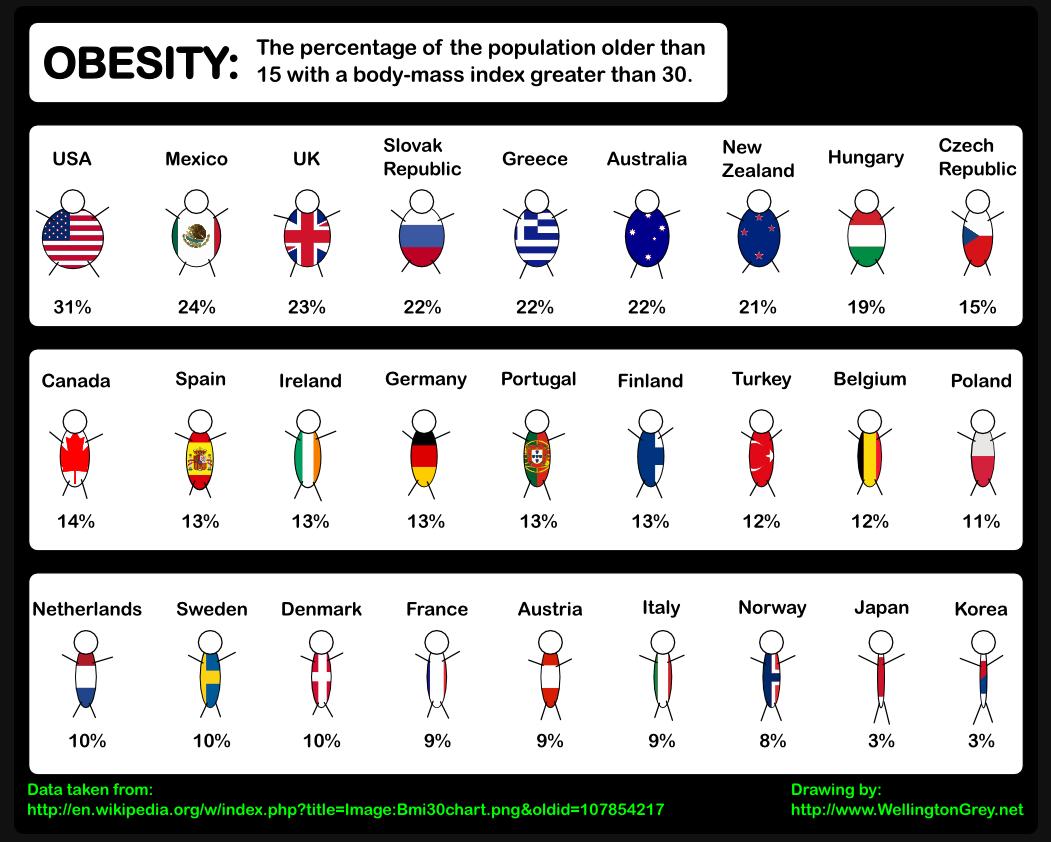
      In 2009 www.globalpost.com compiled a list of the Top 10 Fattest Countries in the world based on national health surveys WHO compiled between 2000 and 2008.
      • What countries do you think were on the list?
      Watch the video and find out.


      3) Discuss
      • Is your country on the list?
      • What do you think causes people to become overweight?
      • Why are we all getting fatter?


      4) Read
      The Obesity Epidemic
      Why are we getting fatter?
      Read the text below and do the gap-fill to find out

      Exam options
      • Click here if you want to do the same text adapted for FCE practice
      • Click here if you want to do the same text adapted for IELTS practice


      5) Listen
      • What do you think is the combined weight of the human race? If you added all our weights together what would it come to?

      Listen and find out


      Listen again and do the true / false exercise


       6) Read
      • What solutions can you think of to prevent world obesity?

      A) Read these quotes from a speech Jamie Oliver made at TED (or watch the clip below)
      What solutions does he give?


      B) Now fill in the gaps with the correct word from the list.


      C) Look at the sentences again.
      1. Which sentences describe the problem?
      2. Which sentences offer solutions?
      3. What language does Jamie use to emphasize the urgency for solutions? 

        Answers - highlight below
        1. 1 - 6  describe the problem
        2. 8 - 14  offer solutions
        3. Urgency - have (got) to, need to, it's (profoundly) important that... , it's time for..., most importantly


        If you have time watch the clip.


        http://www.ted.com/talks/jamie_oliver.html


        7) Write (IELTS)
        Plan and write the following essay
        Obesity is becoming a serious problem in many countries. 
        Explain the main causes and effects of this problem, and suggest some possible solutions. (250 words)


        8) Crossword
        Practise some of the vocabulary used in this post.

        Printable worksheets are here
        Crossword here


        9) More
        More reading and learning activities
        Learning Activities
        Reading


        Obesity Calculator “Obese” is someone with a BMI of 30 or higher. Use this calculator by the National Heart Lung and Blood Institute to see how you score http://www.myenglishpages.com/site_php_files/efl-esl-resources.php?c=6


        Sunday, 6 May 2012

        Supersize Me!

        You are going to 
        • watch a clip from the film "Supersize Me" about fast food
        • do a gap-fill listening exercise
        • discuss the health aspects of eating fast food
        • discuss whether the state should prohibit unhealthy activities
        • write an argument essay based on the topic


        1) Discuss
        • Do you ever eat in fast food restaurants?  Why / Why not?
        • What does “Super size me” mean?
        • Have you seen the film?
        • Is Fast Food good for you?  Why / Why not?
        • Do you think Fast Food restaurants are responsible for making people fat or ill?
        • What would happen if you only ate Fast Food for 1 month?

        You are going to watch 2 clips from Morgan Spurlock's documentary Supersize Me. For 30 days Morgan Spurlock only ate at McDonald's, eating everything on the menu at least once. At the end of the film he examines what effect this diet has had on him.
        You can buy the DVD on amazon here


        2) Before you watch / Vocabulary Check
        Do you know these words?
        OBESE = FAT
        SUED (To Sue) = To take someone to court for damages
        CORONARY = Heart attack
        JOINTS = Restaurants
        FRIVOLOUS = Silly
        STRAIGHT = Consecutively, following = 30 days straight.


        3) Watch the clip
        Why did 2 girls try to sue McDonalds?
        What is Morgan Spurlock going to do for 1 month?


        4) Gap-fill
        Now do the gap-fill. Fill in the gaps with the right number or word.
        Watch the clip again if you need to.


        5) Discuss
        What do you think happened after 30 days of eating nothing but fast food?
        • Did he get fatter?
        • Was he ill?
        • How did he feel?


        6) Watch
        Watch the end of the film.
        1. How much weight did he gain?
        2. What happened to his liver?
        3. What happened to his cholesterol?
        4. Did he get fatter?
        5. How much more likely is he to have a heart failure?
        6. How did he feel?
        7. What happened to his sex life?
        8. Did he become addicted to fast food?


        Answers and printable exercises - here


        7) Discuss
        • If fast food is unhealthy, should it be banned or restricted or is eating it a matter of personal choice?
        • If you think it is a matter of personal choice, should people also be allowed to do other unhealthy or addictive things like drink alcohol, smoke or take illegal drugs? Where do you draw the line between allowing one unhealthy activity and prohibiting or restricting another?
        • Should the government or state tell us what not to eat, drink, smoke or do with our bodies? Is the state trying to interfere with the individual's personal freedom and choice? Can these initiatives ever be successful or are they a waste of money?
        • How do a person's unhealthy habits affect the state or society?

        8) Write
        Write an answer to this question.
        To what extent do you agree or disagree with the following statement? "Fast food is addictive and unhealthy and it should be restricted in the same way that alcohol, cigarettes and drugs are."


        More


        Originally via: OnlineSchools.org

        Fast food facts
        http://www.vivavegie.org/101book/text/nolink/social/supersizeme.htm


        Monday, 2 April 2012

        Should parents follow their children on facebook?

        You are going to
        • discuss social networks
        • listen to some teenagers discussing social networks
        • listen to some teenagers and parents talking about their online relationships and order their comments
        • look at some language used for writing - connectives
        • write a discursive essay on the topic


        1) Discuss
        • Do you use any social networks?
        • Why do people use them?
        • What do you do on them?
        • What effect do you think they have on people?
        • Do they change how you think about other people?
        • Do they make people happy?


        2) Listen
        An American study suggests that social media can affect your thinking about other people. VOA Learning English talked to some young people to find out what they thought

        Questions
        Researchers at Utah Valley University wanted to explore if the amount of time spent on Facebook affected how users saw others.
        • What questions did they ask college students?
        • What did they find?
        • Do you think it's true?
        • What does Tod Kashdan say is important to do?


        Answers - Highlight here = They asked college students if other people have better and happier lives. And, how long they had used the website and how many hours a week they spend following Facebook friends. The study found students who were more involved with Facebook were more likely to think other people's lives were happier.
        Tod Kashdan says it is important to live your own life.


        3) Discuss
        Should parents to follow their children's activities on social network sites? Why / Why not?
        Are you "friends" with your parents / children?


        4) Listen
        Students from around the UK told BBC Radio 4's Woman's Hour about how involved their parents get in their social media lives.
        They discussed whether parents should be "friends" on sites like Facebook, and how much privacy they were allowed.

        Answer
        • How many of the comments are by parents / teenagers?
        • Do they think being "friends" is a good idea?


        Click play to listen

        School Report is an annual BBC project which helps young people make their own news reports for a real audience. http://www.bbc.co.uk/schoolreport/17388168


        5) Put the comments in order
        Read the comments below. Listen again and put them in the order you hear by choosing a number form the drop-down menu.


        6) Informal expressions
        These common informal expressions have been edited out
        ... and stuff... 
         ...it's like...  it's kind of like sort of...
        I'm like...

        What do they mean?
        Highlight = for answers 
        ... and stuff...   = etc 
         ...it's like...  it's kind of like sort of... = describing something 
        I'm like... = can be used like reported speech eg I'm like "Leave me alone!" or describe feelings eg I'm like so angry / happy...


        7) Discuss
        "If you post something that your mum won't be happy with then it's really not suitable"
        • What kind of things do you think are suitable to post on a social network?
        • What are the dangers of posting unsuitable material?


        8) Writing / Connectives
        If we are speaking we use quite informal language. However if we are writing we should use more formal expressions. Look at these connectives / linking words.

        ESSAY WRITING LANGUAGE
        Don’t forget to have an introduction
        Introduce the topic and question

        ORGANISING POINTS
        Firstly
        Furthermore
        In addition
        ANALYSIS
        So
        Therefore
        That is why
        As a consequence
        As a result of this / that
        CONTRAST
        However
        Nevertheless
        On the other hand
        GENERALIZING
        In general
        Generally
        On the whole
        GIVING EXAMPLES
        For example
        For instance
        OPINION
        It’s my opinion that…
        It seems to me that...
        I agree that...
        I am convinced that...
        It seems obvious to me that...
        CONCLUSION
        Finally
        To sum up
        When all is said and done
        After careful thought we can see that...
        It can be seen that...
        In conclusion


        Fill in the gaps with the connectives shown

        Printable versions here


        9) Read and discuss
        Look at the information below.

        • How many parents send a friend request to their kids?
        • What do they look at on facebook?
        • What else do they look at?
        • Do you find any of the statistics surprising?

        Vocabulary
        Keep tabs = follow
        Snooping = spying
        nosy =  curiosity about other people's affairs.


        Parents on Facebook

        Courtesy of: Online Schools


        10) Write
        "Children and teenagers are vulnerable on social networks and many are on facebook without their parents' permission" 
        To what extent do you agree with this statement? Do you think it is justified for parents to follow their children's activities or is it an invasion of privacy?
        Give reasons for your answer using your own ideas and experience.


        More
        More Connectives http://www.english-at-home.com/grammar/linking-words/

        More reading
        http://www.safetyweb.com/social-networking-safety-tips

        Quiz. Are you addicted to facebook?
        http://theoatmeal.com/quiz/facebook_addict/go

        More on writing arguments and linking words
        http://efllecturer.blogspot.co.uk/2011/11/could-you-live-without-it.html


        More on EFL SMARTblog
        Sexting: is technology endangering teenagers? Advanced, Discussion Activities, Health and Safety, IELTS, Listening, Sexting, Smartphones, Technology, Upper Intermediate